
The word has gone crazy…COVID, a million accounting regulation changes, constant bombardment of “new” ways to approach work, constant emergence of “new” tools to automate accounting processes, everyone trying to convince you that their way is better, and in the meantime, crisis after crisis after crisis…. AAAAAAAAAHHHH!
So to keep up, you pick one of these new tools or new frameworks and try it…and it never works — seriously, like NEVER. Because when the rubber actually meets the road, it is not what you bought (or thought you bought), you ran out of time to implement properly, or it has weird quirks that the sales guy didn’t tell you about, etc. In short, lots of PAIN.
As for you, here’s a pile of newly added administrative overhead inherent in your new tool or framework — OMG! More?
The cookie crumbles this way because these tools and frameworks are complex. So complex that there are people specializing in their setup and implementation as a CAREER.
If you are lucky and have the budget to hire one of these experts, you still end up frustrated and the new tool gets abandoned while you go back to your manual Excel and paper process. Why’s that? Because it is faster. Not easier, but FASTER. You can type something in or print something faster than you can click 20 buttons in the newly added tool.
In the meantime, you’ve now run through your implementation budget, so you have to solve anything that goes wrong yourself….you don’t have time for this.
The truth of the matter is, big bold changes never stick because the learning curve is too steep. It is too hard to stop what you’ve been doing for 5–10–15 years and utilize a brand new tool that you have to LEARN from scratch. You don’t have time for this either.
So this is a no-win scenario. Nothing ever EVER changes and the struggle continues. What are we to do?
Answer: Agile Accounting.
Whaaaaaaaat!?
Yes.
Let’s get away from the term “Agile” for a minute and talk about the spirit of the framework. The key concept of this framework is iterative, small changes that can be tested and implemented quickly and without much disruption to someone’s work/day — let’s call it “100 small steps” (wink to Thom Ewen) to avoid getting hung up on the term “Agile” and all the “baggage” (epics, stories, etc.) that comes with it and makes it complex.
Ok, fine. But how does that actually apply to accounting? Accounting is historically a repetitive field of work where you close the month every month and do the same tasks over and over again. What can we possibly do with the “100 steps”? Reconcile GLs? Nope!
You are right. It seems like what accounting does is repetitive and routine and “Agile” — as it has been used until now — only works for the teams that are creating new things, like software developers and other designers. The truth of the matter is, there is so much change that is happening in the world right now that we, accountants, no longer only do the routine tasks — we are forced to innovate, implement things, collaborate with other departments to get the information we need, and help ourselves by improving our own work processes to be able to meet all these increasing demands — that’s A LOT. In other words, we now have to both do our repetitive tasks AND continuously create something new. Also, notice how our repetitive tasks are being more and more automated by the myriads of new software that comes out every day with their AI? What’s going to be left for us at the end of the day? Yup, the “creating something new” bits!
I know you know that this is what our reality looks like, and that’s why you lobbied for and implemented that new tool or new structure. But implementation was rushed by the executive management, or you ran out of time to fully implement and the tool is now more work than it’s worth in its half-finished state. Or maybe a structure was pushed on you by the executive management altogether and it simply does not work when the rubber meets the road.
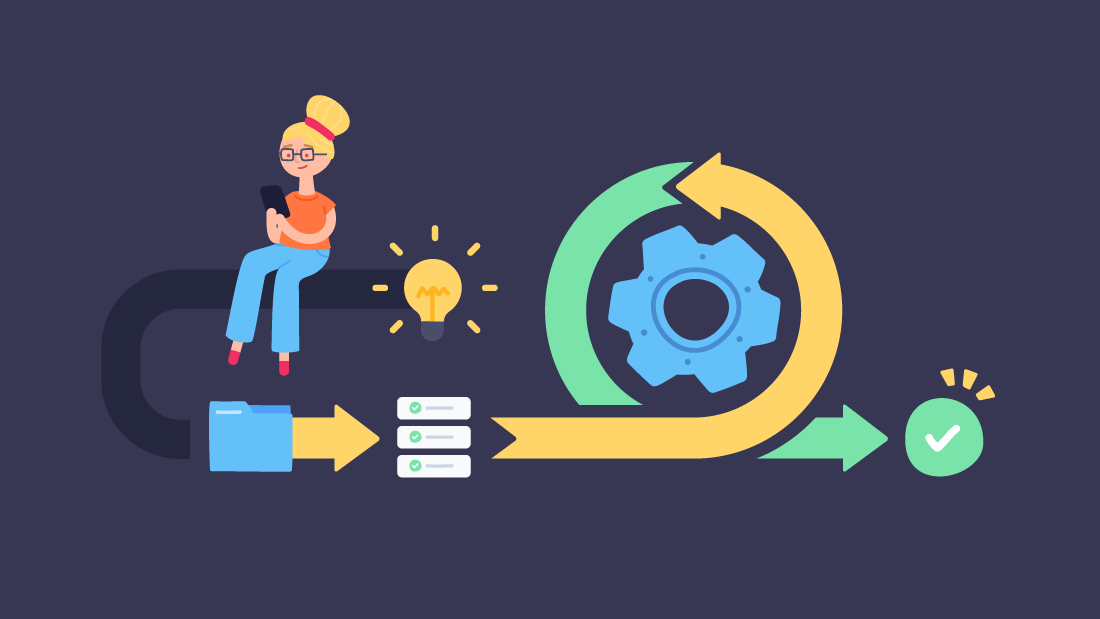
In either case, following a modified, adapted form of Agile methodology will help. Why? Because it will not be a drastic change, but a series of SMALL changes that move you toward a better [insert what you want to improve here].
Let me give a quick example. Let’s say you’ve implemented Oracle as your ERP and you just ran out of time and money to figure out the Fixed Assets module, so now you’re still keeping track of your assets and depreciation in Excel and doing Journal Entries for this manually on monthly basis. Worse yet, you know that you will never get a chance to get around to setting it up and turning it on since you have to also close the month and do your daily tasks.
The Agile process can make this happen:
How can we break up this project into small chunks? First, we need to learn how the module works and find out what it will take to get it set up. Then, you have to do the setup, create the worksheets to upload, or manually start entering your assets into the module. So, let’s say that this month, we will find 3 hours to learn about the module. Yes, that’s ALL we’re going to do this month for this project. Ok, now we found out what we need to do, what data to gather, and what worksheet to fill out. Let’s say we have 100 assets to set up. That’s a lot of work. Yes, but what if we set up 5? 10? at a time. Let’s say we set a goal to create and load 5 assets per week and it will take us 2 hours to do this. So, every week we set up 5 assets for 20 weeks. In 5 months, you have all of the assets in the module and you are NO LONGER making the manual entry for depreciation and simply verifying that the process ran correctly.
Slow? Yup! But we are still further along than never doing the project altogether because it’s too big to take on end-to-end. Now imagine everyone on your team takes on one project like this and follows this simple framework. How much better off can your team be in 6 months? In 12 months?
Of course, this is an oversimplified example and more complex projects will require a heavier lift, planning, and coordination, but it does illustrate this way of thinking. A way to improve your situation without adding a huge amount to your plate. And the BEST part? You can stop at any time in the middle of a project — go ahead and attend to that fire that fell into your lap, or take care of that audit — WITHOUT losing momentum or having to start from scratch. This is because the work you have done to this point is stand-alone, fully functional, and finished.
 Lead. Drive Change.
One thought on “Agile Accounting: Why nothing ever works and how to fix it.”