

Are you trustworthy? If you’re like most people, you were quick to say yes, and as you guessed the question was loaded. You understand that earning trust within your team and greater organization is critical to success in a professional setting, but consider that there are multiple types of trust.
Notice that when we make statements like “I trust this person, he’s good people” or “She’ll get the job done” you’re really saying “I trust this person will act with good intentions and integrity” or “I can trust them to reliably deliver on their commitments”. These statements highlight people measuring different types of distinct trust. Trusting that someone has good intentions does not mean that you trust them to reliably deliver on their commitments. These are entirely separate types of trust.
I have created a model that highlights the 5 most important types of trust required for professional success and organizes them by order of importance. Let’s touch on them:
Positive Intent
Positive Intent is the most important form of trust one needs to establish, as it acts as the foundational trust that unifies a team and organization. It reflects a person’s integrity and commitment to ethical practices and is more than simply being confident in their capabilities. This trust is key as it forms the basis of all further team interactions and achievements. Without it, a team cannot function cohesively.
Ask yourself: Am I trusted to act with good intentions and integrity?
Reliability
Reliability is the next level of trust that builds upon the foundations of positive intent. It involves consistently fulfilling promises and achieving positive outcomes, proving that one’s actions align with their words. Many of us have a tendency to over promise and then fail to deliver on tasks big or small, resulting in a loss of trust. For example, consistently failing to deliver small tasks, such as a promised email follow up, has a negative impact on the Reliability trust type and results in low levels of trust over time. Do what you say, have positive outcomes, and avoid making commitments big or small that you cannot deliver on. These things will add up quickly over time.
Ask yourself: Am I trusted to deliver what I promise?
Strategic Opportunity
Strategic Opportunity focuses on strategic foresight and big picture thinking rather than daily responsibilities. Having a high level of trust means people believe that your decisions and goals consider long-term impacts and align with broader organizational objectives. You will be encouraged to engage in forward thinking and innovative opportunities, with others confident that they are being steered towards important and beneficial opportunities.
Ask yourself: Do I show an understanding of the big picture and think strategically?
Understanding People
Understanding People is a measure of how well you build relationships, maintain relationships, and leverage those relationships to accomplish shared strategic goals. High levels of trust here mean you are trusted to understand others’ motivations and use that understanding to build bridges between teams and create coalitions to accomplish mutual goals.
Ask yourself: Am I trusted to build strategic relationships that help successfully execute on strategy?
Developing Others
Developing Others is the trust that you are committed and skilled at growing an individual’s professional skills. High levels of trust here mean others believe you will help them reach their professional goals, help grow the team, and can even help develop your own leaders. As the final trust type, it is dependent on high levels of trust at all other levels to be effective. Leaders, if this type of trust is neglected you will lose good employees that are not content with professional stagnation.
Ask yourself: Am I trusted to help others achieve professional growth?
These levels of trust can be remembered by the acronym PROUD – so take pride in earning the trust of others! Each level builds on the last, creating a comprehensive trust framework that can significantly enhance your performance, your team’s performance, and your ability to lead with maximum impact. Each level of trust only reaches maximum effectiveness if the previous type of trust has been earned.
Example 1: Jeanette has shown for years that she can reliably get things done and have a positive result, and thus, has earned the Reliability trust type from her team. However, she has shown time and time again that she acts selfishly when given the opportunity and not in the team’s best interest, resulting in a low level of the Positive Intent trust type. When the team is tasked to work on a large project with her, they second guess her intentions, causing them to not be fully transparent with her. The end result is Jeanette missing key information and struggling to deliver her part of the project, delaying the delivery date and lowering the final quality of the deliverable.
Example 2: John is a manager and is well known for developing others in 1:1 sessions. He is currently helping a member of his team with professional development. However, John is referred to as a “bull in a china shop” in how he manages his strategic relationships. The team member wants to ask John if he will help him get into his organization’s well known leadership program but is afraid that if John tries to help him or even endorses him it will lower his chances of success. The team member thinks it’s better to not bring it up. Low trust in Understanding People has negatively impacted Johns ability to develop his team despite high trust in his Developing Others trust type.
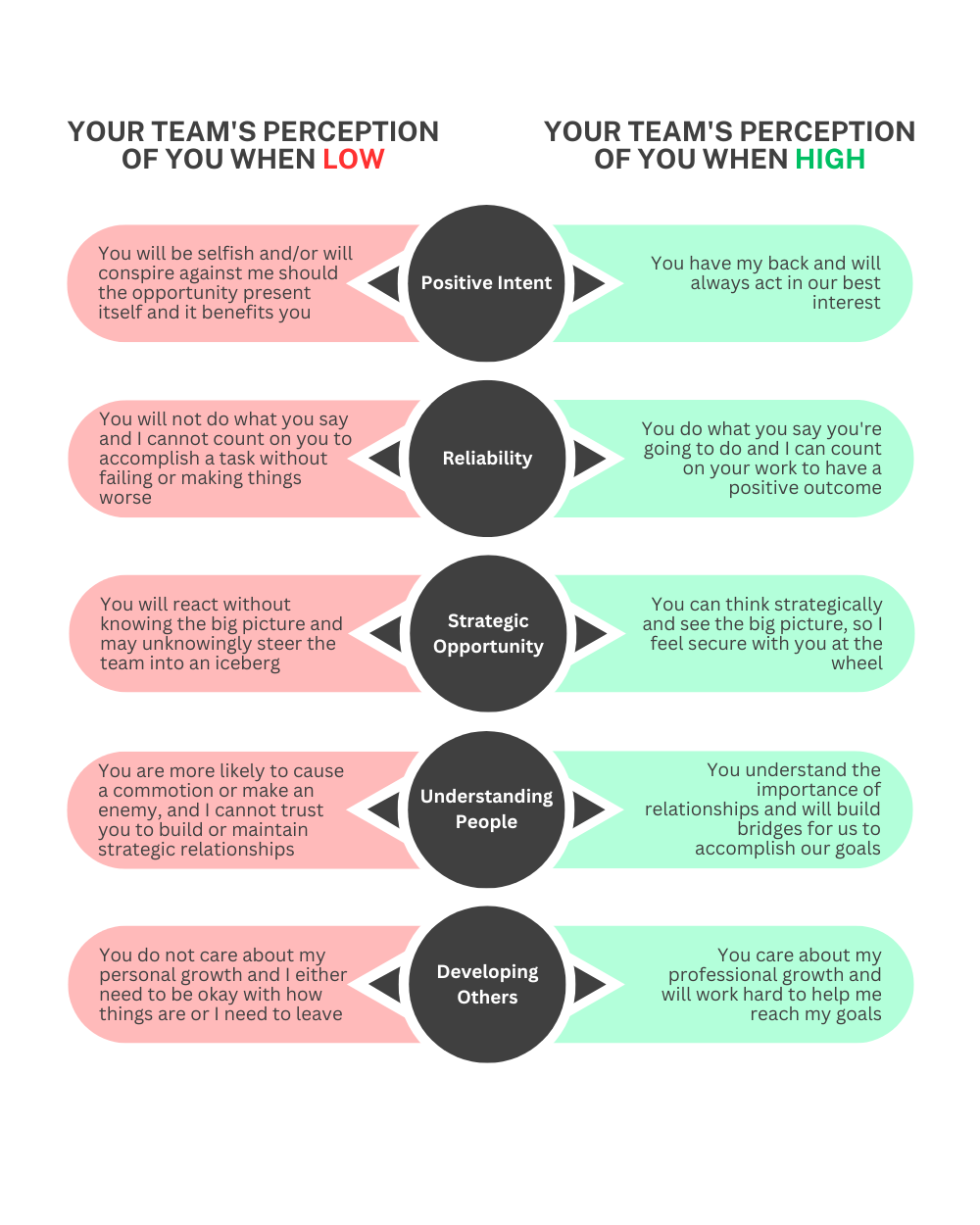
Building trust is not just a one step process. By understanding the PROUD model—Positive Intent, Reliability, Strategic Opportunity, Understanding People, and Developing Others— you can build levels of trust that improves team cohesion and morale while also maximizing your chances of professional success. Leaders who highlight and focus on building these five levels of trust directly within their team will see immediate benefits to their team’s effectiveness and happiness.
Ready to dive deeper into cultivating trust? Stay tuned for our next post, where we’ll explore practical strategies for measuring your team’s levels of trust. In the meantime, reflect on how you can apply the principles of trust building in your day to day interactions. Share your thoughts and experiences in the comments below!
 Lead. Drive Change.